
17 November, 2025
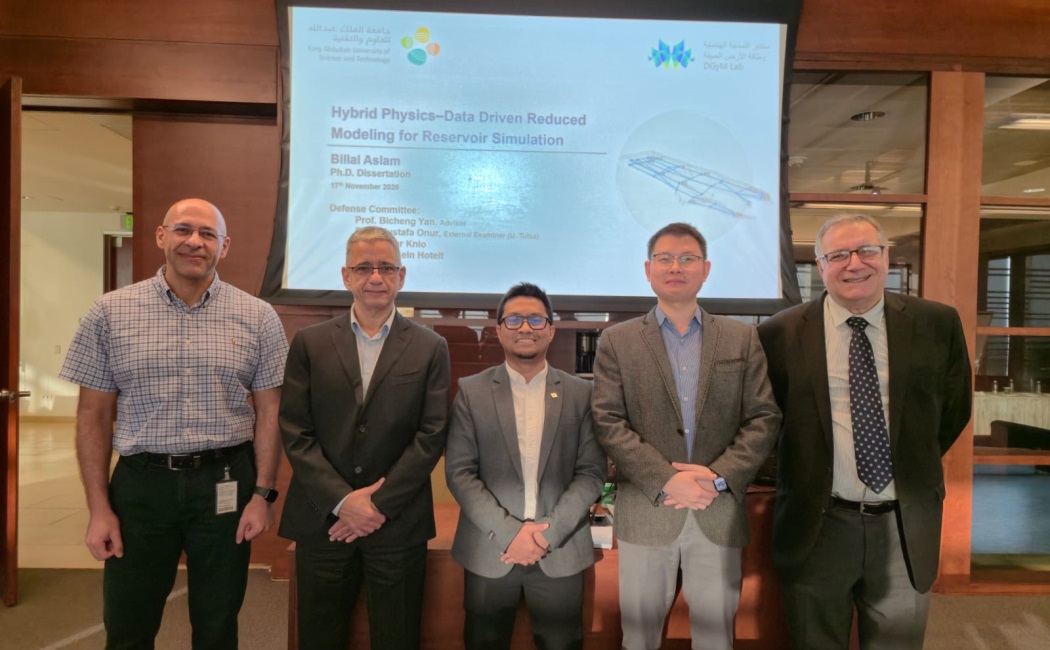
Billal Aslam, a Ph.D. candidate in the Energy Resources and Petroleum Engineering (ErPE) program at King Abdullah University of Science and Technology (KAUST), has successfully defended his Ph.D. dissertation titled “Hybrid Physics–Data-Driven Reduced Modeling for Reservoir Simulation.”
His research, conducted under the supervision of Professor Bicheng Yan, focuses on developing fast, accurate, and physically consistent reduced models to address the computational challenges of large-scale reservoir simulation. By combining numerical simulation with deep-learning techniques, his work enables efficient history matching and optimization in complex subsurface systems, with application ranging from CO₂ sequestration and waterflooding in fractured and heterogeneous reservoirs. The defense committee was chaired by Professor Hussein Hoteit and included Professor Bicheng Yan as his advisor, Professor Omar Knio, and external examiner Professor Mustafa Onur (University of Tulsa).
Dissertation Abstract:
Reservoir simulation is essential for optimizing geo-energy recovery and geostorage systems. Despite advances in numerical methods and high-performance computing (HPC), realistic reservoir models remain computationally prohibitive for workflows such as assisted history matching, uncertainty quantification, and optimization, which require numerous forward simulations. This motivates the development of surrogate models that approximate fine-scale models with reduced computational cost.
Hybrid surrogate methods, such as graph-based numerical models, have attracted growing interest because they combine physical interpretability with computational efficiency. Among them, the coarse-grid network (CGNet) represents a reservoir through a graph derived from coarse partitioning of the reference model grid, where flow equations are solved using finite-volume discretization on the network. Compared with other hybrid approaches, CGNet offers greater flexibility and interpretability, with more connections and tunable parameters that enable efficient calibration against well data or reference simulations.
This dissertation extends the CGNet framework to overcome key limitations that have restricted its application in complex reservoir settings. First, CGNet is applied to CO₂ geological sequestration, where the model is calibrated to well data and upscaled plume distributions to enable accurate prediction and optimized injection–extraction strategies for pressure management within a multi-fidelity optimization framework. Second, CGNet is generalized to fractured reservoirs: sparse fracture systems are represented using explicit diagonal connections along fracture paths, while densely fractured reservoirs are modeled through a dual-continuum CGNet that captures matrix–fracture interactions.
To complement the physics-based CGNet framework, deep learning is employed to enhance spatial resolution and enable efficient parameter estimation. A super-resolution deep neural network (SR-DNN) reconstructs fine-scale pressure and saturation fields from coarse simulations, improving predictive accuracy in multiphase flow scenarios. In addition, a deep learning inference network is coupled with differentiable surrogates to enable deterministic history matching, assimilating multi-source production and monitoring data to estimate heterogeneous model parameters efficiently.
Together, these developments establish a versatile hybrid surrogate modeling framework that significantly accelerates reservoir simulation while preserving accuracy and physical consistency. The proposed methods provide practical tools for rapid optimization, history matching, and performance forecasting across diverse subsurface processes, including CO₂ storage and waterflooding in fractured and heterogeneous reservoirs.